Just got an EV and not sure what home charging actually involves? Here's a plain-language breakdown of how it works, what it costs, and what to expect in Tarrant County.
Share:
Summary:
You just got your EV. You plugged in the cord that came in the box, checked the app, and realized it’s going to take two days to get a full charge. That’s not a malfunction — that’s just Level 1 charging doing what Level 1 charging does. The good news is there’s a straightforward fix, and most homes in Tarrant County can handle it without major electrical work. Here’s what you actually need to know about charging your electric car at home — what the equipment is, how fast it works, what installation looks like, and how to make sure the job gets done right.
Here’s something that trips up almost every first-time EV owner: the terminology. You’ll see “home charger,” “charging station,” “charging point,” and “EVSE” used interchangeably across manufacturer websites, forums, and installation guides — and it’s genuinely confusing because they all refer to the same wall-mounted unit. The actual charger is built into your car. What you’re installing at home is the equipment that delivers power to it.
So when someone says “electric car home charging station” or “home car charging point,” they mean the same thing: a dedicated piece of hardware, wired into your home’s electrical system, that feeds your vehicle a steady stream of power at a much higher rate than a standard outlet can provide. Once you understand that, the rest of it gets a lot easier to follow.

Level 1 charging uses a standard 120-volt household outlet — the same kind you’d plug a lamp into. It adds roughly 3 to 5 miles of range per hour. For a plug-in hybrid with a small battery, that’s often fine. For a full battery electric vehicle, it means that if you come home with a significantly depleted battery, you may still be looking at a partially charged car the next morning.
Level 2 charging operates on a 240-volt circuit — the same voltage as a clothes dryer or an electric oven. It delivers 20 to 40 miles of range per hour, which means most EVs go from low to fully charged overnight without any drama. You plug in when you get home, and by the time you leave in the morning, you’re full. That’s the practical difference, and for most people, it’s the difference between an EV that fits their life and one that causes daily stress.
The hardware itself — the Level 2 unit — typically runs between $400 and $1,200 depending on the brand, the amperage, and whether it has smart features like Wi-Fi scheduling or energy monitoring. A basic 32-amp unit handles most vehicles just fine. A 48-amp smart charger gives you more speed and more control, which some households find worth the extra cost.
The total cost of installation, including the dedicated 240-volt circuit, wiring, breaker, and labor, typically falls between $800 and $2,500 for a straightforward residential job in Tarrant County. Homes that need a panel upgrade to support the new circuit will see higher costs, but that’s not the case for every home — and it’s something a proper site assessment will tell you upfront.
One thing worth knowing: a Level 2 charger requires its own dedicated circuit. It can’t share a breaker with your washer, your dryer, or anything else. That’s a code requirement, not a preference — and it’s one of the reasons this job belongs with a licensed electrician rather than a handyman or a DIY project.
Short answer: brand matters less than compatibility and installation quality. Most Level 2 home chargers use the J1772 connector, which works with the vast majority of non-Tesla EVs on the market. Tesla vehicles use the NACS connector, though adapters exist and the industry is actively standardizing around NACS. Before you purchase any charger, confirm that it’s compatible with your specific vehicle — your car’s manual or the manufacturer’s website will tell you what connector type you need.
That said, the brands that tend to come up most often in residential installations are ChargePoint, JuiceBox, Grizzl-E, and the Tesla Wall Connector. Each has its strengths. ChargePoint and JuiceBox are popular for their app connectivity and scheduling features, which let you charge during off-peak hours when electricity rates are lower. Grizzl-E is known for being durable and straightforward — no app required, which some people prefer. The Tesla Wall Connector is the obvious choice for Tesla owners who want a seamless, integrated experience.
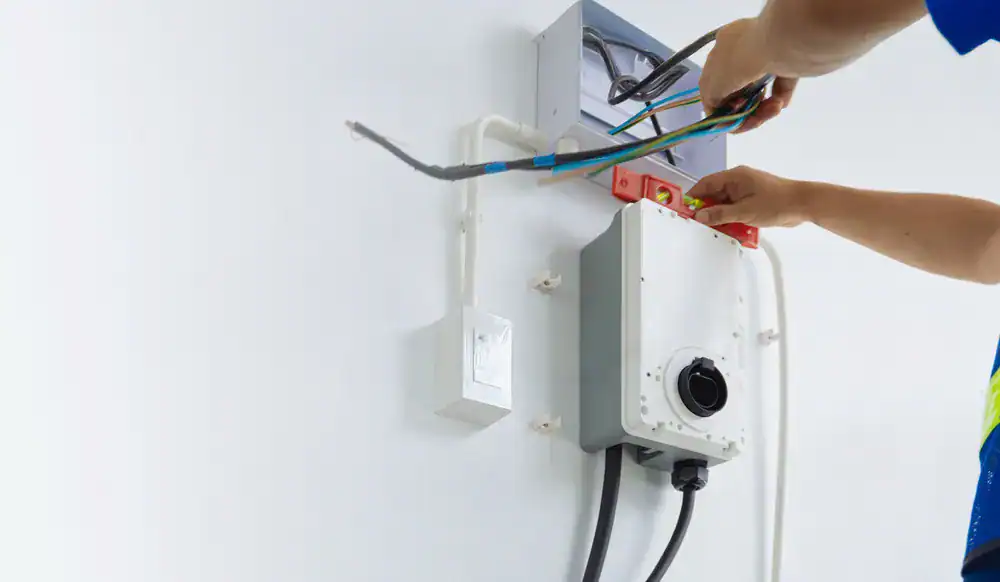
What actually makes the biggest difference isn’t which brand you pick — it’s how the installation is done. A properly sized circuit, correctly rated breaker, quality wiring, and a unit that’s been mounted and tested by someone who knows what they’re doing will outlast and outperform a name-brand charger installed carelessly. We work with all of the major charger brands and are certified Tesla installers, so regardless of what you’re driving or what hardware you’ve already purchased, we can make it work safely and correctly.
One more thing that often gets overlooked: placement. Where the charger gets mounted matters — both for cable reach to your vehicle’s charge port and for weatherproofing if it’s going in a garage versus on an exterior wall. These are decisions we’ll walk you through before any wiring starts, not after.
Tarrant County has over 21,500 registered EVs as of late 2024 — fifth highest of any county in Texas — and that number is climbing fast. The DFW region as a whole has more registered electric vehicles than Houston or San Antonio, which means electricians in this area are seeing a significant uptick in home charger installation requests. That’s context worth knowing, because it means local permitting offices, utility providers, and contractors are all getting more familiar with the process.
What it also means is that if you’ve just taken delivery of a new EV in Keller, Fort Worth, Southlake, or anywhere else in Tarrant County, you’re not the first person on your block to go through this. The process is well-established, and most installations go smoothly.

Yes — in most DFW cities, a permit is required for EV charger installation. This applies whether you’re adding a new 240-volt circuit from scratch or hardwiring a charging station directly into your panel. The permit process involves a licensed electrician pulling the permit, completing the work, and then passing a city inspection before the job is officially closed out.
The inspection exists to confirm that the circuit is properly sized, the wiring meets code, the breaker is correctly rated, and the installation is safe for long-term use. EV chargers draw a continuous high electrical load — unlike most appliances that cycle on and off — which means the wiring and breaker have to be sized to handle that sustained demand. An inspection catches problems before they become hazards.
The practical implication for homeowners is simple: don’t hire someone who isn’t going to pull a permit. If a contractor skips permits, you’re left with work that hasn’t been inspected, which can create problems with your homeowner’s insurance and complicate things if you ever sell the house. We handle all permitting as part of every installation — you don’t have to navigate city offices or figure out the paperwork yourself.
Permit fees across Tarrant County typically range from $50 to $800 depending on the specific jurisdiction. That cost is part of the total project estimate we provide upfront after our free assessment, so there are no surprises when the bill arrives.
This is the question that makes most Tarrant County homeowners nervous, and understandably so. The short version: many homes can support a Level 2 charger without any panel work at all. Newer construction — particularly in communities like Keller, Southlake, Mansfield, and the master-planned developments that have gone up across North Tarrant County over the past 20 years — typically comes with 200-amp panels that have room to add a dedicated EV circuit. If your home was built in the last two decades, there’s a reasonable chance you’re already in good shape.
Older homes are a different story. Properties built in the 1970s, 80s, or early 90s — common in Fort Worth’s inner suburbs and some of Tarrant County’s more established neighborhoods — often came with 100-amp service. That’s enough for the home’s original electrical load, but adding a 40- or 50-amp EV circuit on top of everything else can push an older panel beyond its capacity. In those cases, a panel upgrade to 200-amp service is the right move before an EV charger goes in. Panel upgrades typically run $1,500 to $3,000 depending on the scope of work, and they benefit the entire home — not just the EV charging.
We’ve been working in DFW homes since the late 1990s, and we know the electrical profile of this region well. We know which neighborhoods in Tarrant County tend to have undersized panels, which areas have older wiring that needs attention alongside a new circuit, and what local inspectors look for. When we come out for a free assessment, we’re not just looking at where to mount the charger — we’re evaluating the whole picture so we can give you an accurate, upfront number before any work begins.
Texas utility companies also offer rebates of $250 to $1,200 for EV charger installation, depending on your provider. That’s real money back in your pocket, and it’s something we can help you navigate. Most competitors don’t mention this — we think you should know about it before you make any decisions.
Home EV charging isn’t complicated once you understand what you’re actually dealing with. You need a Level 2 charger, a dedicated 240-volt circuit, a licensed electrician to install it correctly and pull the required permits, and a site assessment to confirm your panel can handle the load. That’s the whole picture.
Most Tarrant County homeowners are surprised by how straightforward the process is — and how quickly it changes the day-to-day experience of owning an electric vehicle. Waking up to a full charge every morning is a different life than watching a Level 1 cord crawl toward 80% overnight.
If you’re ready to move forward — or just want to know what your home actually needs before committing to anything — a href=”https://carrollservicecotx.com/about-us/”>Carroll Service Co offers a free assessment with upfront pricing and no hidden fees. We’re licensed (TECL 25420), locally owned, and have been doing this work in DFW homes for over 25 years. Reach out and we’ll take it from there.
Article details:
Share:
Continue learning: