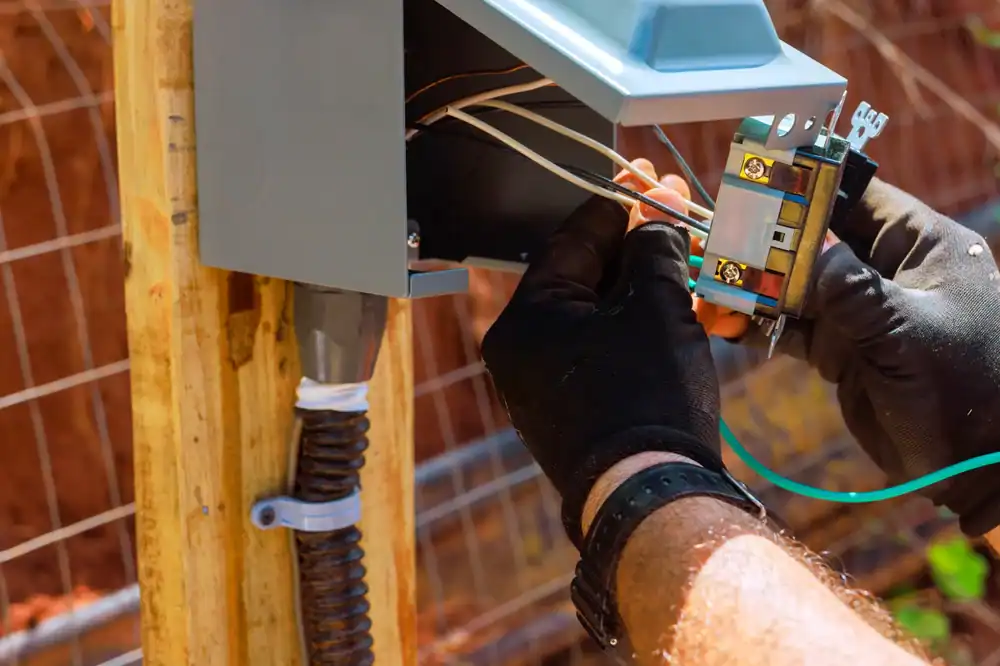
Your home's wiring gives off warning signs before things go wrong. Here's what those signs actually mean — and when to act.
Share:
Summary:
Your house has been trying to tell you something. Maybe the lights dim every time the AC kicks on. Maybe one breaker in the panel trips more than it should. Maybe there’s an occasional burning smell near an outlet that disappears before you can track it down. These aren’t quirks — they’re symptoms. And in a Tarrant County home built in the 1980s or 1990s, they often point to the same underlying problem: an electrical system that was never designed to handle what you’re asking it to do today. Here’s what’s actually going on, and what it means for your home.
Your home’s electrical system starts at the service entrance — where power from the ONCOR grid comes in — and flows through your main panel, which divides it into individual circuits. Each circuit runs through your walls, feeding outlets, switches, fixtures, and appliances. The wiring itself is the backbone of all of it.
What most people don’t realize is that the panel has a capacity limit. Homes built before 2000 in Tarrant County were typically wired for 100-amp service — enough for the appliances and demands of that era. Today, with central HVAC systems, EV chargers, home offices, and smart home devices all running simultaneously, that same panel is often stretched well past what it was designed for.
The wiring doesn’t fail all at once. It shows you warning signs first.

A large share of the housing stock in communities like Keller, Grapevine, Haltom City, and the Mid-Cities corridor was built during the 1980s and early 1990s. These homes were wired to the standards of their time — and those standards simply didn’t anticipate the electrical load of a modern household.
The 100-amp panels common in pre-2000 construction weren’t designed for multi-zone HVAC, induction ranges, or a 240V circuit for an EV charger. When you push more demand through a system than it was sized for, the panel responds by tripping breakers. The wiring responds by running hot. Over time, insulation around older wiring can degrade, connections at outlets and junction boxes can loosen, and the risk of an arc fault — a spark inside a wall — increases.
There’s also the aluminum wiring issue. Homes built in the late 1960s through early 1970s sometimes used aluminum branch circuit wiring instead of copper, because copper prices spiked during that period. Aluminum wiring isn’t inherently dangerous if it’s properly maintained and connected with compatible devices, but it does carry a higher fire risk at connection points as it ages.
Then there’s something specific to Tarrant County that doesn’t get talked about enough: clay soil. The expansive clay soil throughout much of this area shifts with moisture changes — and that movement stresses underground conduit and buried wiring over time. Ground faults that develop slowly in buried wiring are notoriously difficult to diagnose without professional equipment. It’s a local factor that doesn’t show up on a national home safety checklist, but it’s real.
Fort Worth adopted the 2023 National Electrical Code effective March 1, 2024, which expanded arc-fault circuit interrupter (AFCI) protection requirements. That means older homes are increasingly out of step with current code — not necessarily a legal problem until you sell or pull a permit, but worth understanding if you’re planning any work.
The most common thing homeowners do when a breaker trips is walk to the panel, flip it back, and move on. That works fine if it happens once. When it keeps happening — same breaker, same conditions — it’s telling you the circuit is consistently overloaded or there’s a fault somewhere in the wiring. Resetting it doesn’t fix anything. It just delays the diagnosis.
Flickering or dimming lights are another symptom that gets rationalized away. It’s easy to assume a bulb is going bad or a fixture is old. But light fixtures draw a relatively small amount of power. If your lights dim when the AC compressor starts, the problem isn’t the fixture — it’s upstream. The voltage drop you’re seeing is the circuit struggling to handle the startup load of a large appliance. That’s a circuit or panel issue, not a lighting issue.
Burning smells near outlets or the breaker panel are the symptom that should prompt the fastest response. If you smell something that resembles burning plastic near an outlet, turn off and unplug everything connected to it and don’t use it again until it’s been inspected. The same applies to any unusual odor near the panel itself. Electrical fires frequently start inside walls — often long before any visible sign appears. The smell is the early warning.
Warm outlets, discolored outlet covers, and outlets or switches that buzz or crackle are all in the same category. None of these are normal. None of them are something to monitor and revisit later. They’re signs that something is happening at the connection point — a loose wire, an overloaded circuit, or a failing device — and those conditions don’t improve on their own.
One more worth mentioning: if your home has outlets without a third grounding prong in areas like the kitchen, bathrooms, or garage, that’s a code compliance issue. Modern GFCI and AFCI protection standards exist because ground faults and arc faults are among the leading causes of electrical fires. Older homes that haven’t been updated often lack this protection entirely.
Not every wiring problem requires a full rewire. Many issues — a failing outlet, a loose connection at a junction box, a single circuit that needs to be added or upgraded — are straightforward repairs. But some symptoms point to something more systemic, and it’s worth understanding the difference before assuming a quick fix will hold.
The key question is whether the problem is isolated or recurring. A single outlet that stopped working is usually a repair. Breakers tripping repeatedly across multiple circuits during peak demand — especially in a Tarrant County summer when the AC runs all day — often points to a panel that’s undersized for the home’s current load. That’s a different conversation.

When a licensed electrician comes out to diagnose a wiring problem, they’re not just looking at the symptom you called about. They’re tracing it back to the source. A warm outlet might be a loose connection at the device itself — a simple fix. It might also be a sign that the circuit is consistently running near capacity, which means the outlet is just where the heat is showing up, not where the problem originates.
Common repairs in older Tarrant County homes include replacing failing outlets and switches, upgrading ungrounded two-prong outlets to GFCI-protected three-prong outlets, adding circuits for new appliances or home office equipment, correcting aluminum wiring connections with compatible devices or pigtailing with copper, and replacing individual breakers that have worn out or are no longer tripping correctly.
What separates a repair from a larger project is usually the panel. If the panel itself is undersized, outdated, or showing signs of failure — breakers that won’t hold, visible corrosion, a panel brand with a known history of issues — repairs to individual circuits will only go so far. You can fix the outlet, but if the panel feeding it is already maxed out, the underlying problem remains.
It’s also worth knowing that any significant electrical work in Fort Worth requires permits and inspections. Unpermitted work doesn’t just create a legal risk — it can result in insurance claim denials and forced corrections when you sell. A licensed contractor handles the permit process, meets the inspector on-site, and makes sure the work is documented. That documentation matters more than most homeowners realize until they’re sitting across from a home inspector at closing.
A lot of the electrical work we do in Tarrant County homes isn’t about fixing something that broke — it’s about adding capacity for something new. A home addition, a kitchen remodel, a new HVAC system, a dedicated circuit for a home office, or a 240V outlet for an EV charger all require new wiring installation. And in most cases, they also require a conversation about whether the existing panel can support the added load.
Texas had over 150,000 registered electric vehicles by late 2024, and that number is climbing. A standard 120V outlet will charge an EV, but slowly — most owners with a dedicated home charger want a 240V circuit, which draws significantly more power. Many older DFW homes simply don’t have the available capacity in their panel for a new 240V circuit without an upgrade. Before the installation can happen, a load calculation tells you exactly where the panel stands.
The same applies to home additions and major remodels. Adding square footage means adding circuits, and adding circuits means the panel needs to have room. A proper load calculation — not just a visual inspection — is the right starting point before any new wiring installation. It tells you what you actually have to work with, not just what the panel label says.
One thing that’s easy to overlook in this context: whole-house surge protection. DFW’s spring storm season brings lightning, and the ERCOT grid sees its own fluctuations during summer heat events when demand peaks. A power strip surge protector offers minimal protection against a real voltage spike. Whole-house surge protection installed at the panel level is the only reliable way to protect electronics, appliances, and — importantly — the wiring itself from surge damage. It’s a straightforward installation that gets added during a panel upgrade or as a standalone job.
For homeowners who want to go a step further, we also install the Powerworx Energy Management System, which can reduce electric bills by up to 15% by optimizing how your home uses the power it draws. It’s one of those additions that pays for itself over time, and it’s worth asking about if you’re already having panel work done.
If your home was built before 2000 and you’re noticing any of the symptoms described here — repeated breaker trips, flickering lights when the AC runs, warm outlets, burning smells — the right move is to get a professional diagnosis before the problem gets worse. Most of the time, what you’re dealing with is fixable. The question is whether it’s a repair or a sign that the panel needs attention.
We’ve been doing this work in Tarrant County since 1999. We know the housing stock, we know the code requirements, and we know what it looks like when a 100-amp panel is telling a homeowner it’s time for an upgrade. We handle the permits, meet the inspector, and stand behind everything we do with a warranty on parts and labor.
If something in your home’s electrical system doesn’t feel right, Carroll Service Co is straightforward to reach — and a $75 service call is a low-cost way to find out exactly what you’re dealing with.
Article details:
Share:
Continue learning: