Single-room flickering isn't always harmless. Here's what it usually means, when to worry, and what to do next.
Share:

Summary:
You’ve probably noticed it before — the lights in one room doing that subtle dip or flutter, maybe when you flip a switch, maybe just out of nowhere. The rest of the house is fine, so it’s easy to chalk it up to a bad bulb and forget about it. Sometimes that’s exactly what it is. But single-room flickering has a specific set of causes, and a few of them have nothing to do with the bulb at all. Understanding the difference between a five-dollar fix and something that needs a professional eye can save you a lot of second-guessing — and in some cases, a lot more than that.
The fact that it’s happening in one room — and not the whole house — is actually useful information. It tells you the problem is almost certainly isolated to that room’s circuit, its fixtures, or the wiring feeding them. That narrows things down considerably.
The most common benign causes are a loose bulb, a failing bulb, or a dimmer switch that isn’t compatible with the LED bulbs installed on it. Older dimmer switches were designed for incandescent bulbs, which operate at a much higher wattage. When you pair one of those dimmers with a low-voltage LED, you often get flickering — sometimes subtle, sometimes pretty noticeable. Swapping the dimmer for one rated for LEDs usually clears it up immediately.
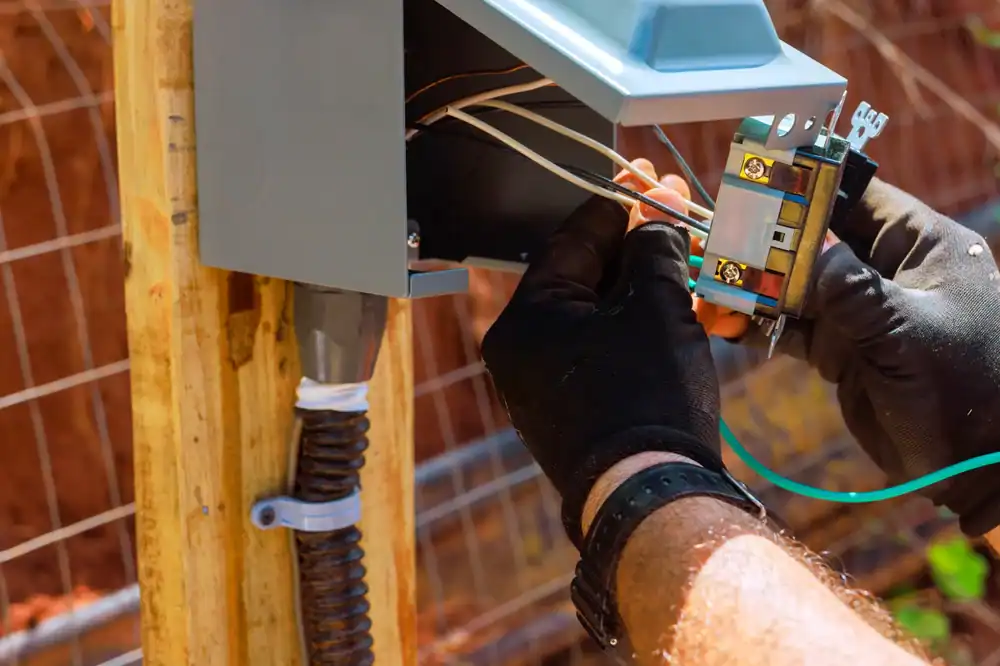
Beyond those quick fixes, the causes get more serious. Loose wiring inside an outlet, switch, or junction box can cause intermittent flickering as the connection makes and breaks contact. A failing circuit breaker — one that’s degrading internally without fully tripping — can deliver inconsistent power to everything on that circuit. And in older homes, years of heat cycling cause wire connections to loosen gradually over time, creating resistance that shows up as flickering before it shows up as anything more alarming.

This one comes up constantly, and it’s worth explaining clearly because the instinct is almost always to blame the hair dryer. The hair dryer isn’t the problem — it’s just the thing that’s revealing one.
A standard hair dryer draws somewhere between 1,500 and 1,875 watts when it’s running at full heat. That’s a significant load. On a 15-amp circuit, you’re working with a maximum capacity of roughly 1,800 watts before things start to strain. When the bathroom circuit is already powering lights, an exhaust fan, and anything else plugged in, turning on a hair dryer can push that circuit right to its limit — or past it. The result is a measurable voltage drop that shows up as a visible flicker in the lights on that same circuit.
What this symptom is actually telling you is that the circuit doesn’t have enough capacity for the load being placed on it. That’s a circuit design issue, not an appliance issue. Switching to a lower-wattage dryer might reduce the flicker, but it doesn’t fix the underlying problem — the circuit is still undersized for how the room is being used.
A circuit that’s regularly running at or near its limit generates more heat at every connection point along the way. Over time, that heat degrades wire insulation, loosens terminal connections, and accelerates wear on the breaker itself. None of that is visible until something fails — which is exactly why this kind of symptom is worth taking seriously rather than just tolerating.
In many Tarrant County homes built before the 1990s, bathroom and bedroom circuits were wired for the electrical loads of that era — not the loads of a modern household. Hair dryers, curling irons, space heaters, and phone chargers all add up in ways that older wiring simply wasn’t designed to accommodate. If your lights dim every time the dryer kicks on, that’s your circuit telling you it’s working harder than it should be.
Loose wiring is the cause most homeowners don’t want to think about — and the one that matters most. When a wire connection inside a switch, outlet, or junction box works loose, it doesn’t necessarily stop working entirely. Instead, it creates an inconsistent connection that causes the lights to flicker as current arcs across the gap.
Arcing is the part worth understanding. When electricity jumps across a loose connection, it generates heat — sometimes extreme heat — at that point. That heat can damage wire insulation, char the surrounding materials, and under the right conditions, ignite them. It doesn’t announce itself. There’s no loud noise, no obvious warning. The flickering is often the only sign something is happening inside the wall.
Homes in Fort Worth, Arlington, and other established Tarrant County neighborhoods — areas like Fairmount, Mistletoe Heights, and Ridglea — frequently have wiring that’s been in place for 40, 50, or even 60 years. Connections that were solid when they were made have gone through decades of heat cycles as the seasons change, and that expansion and contraction gradually works connections loose. It’s not a sign of bad original workmanship. It’s just physics, and it’s one of the most common findings when we diagnose persistent single-room flickering in older homes across the DFW area.
Aluminum wiring adds another layer of concern. Many homes built between 1965 and 1973 were wired with aluminum rather than copper, and aluminum is known to degrade at connection points in ways that copper doesn’t. If your home was built during that period and you’re seeing flickering, that’s a combination worth having a licensed electrician look at specifically.
A failing circuit breaker is another cause that often gets overlooked. Breakers don’t always fail by tripping — sometimes they degrade internally and begin delivering inconsistent power to the circuit they control. If the flickering is happening across everything in a room rather than at a single fixture, and especially if it’s getting worse over time, the breaker is worth inspecting.
The location of the flickering is one of the most useful diagnostic clues we have. Single-room flickering almost always points to something on that room’s circuit — the wiring, the fixtures, the breaker, or the load. Whole-house flickering, especially if lights are dimming in one room while brightening in another simultaneously, points toward something at the panel level or even at the utility connection — and that’s a different conversation entirely.
If you’re seeing flickering only in one room, that’s actually the more contained scenario. It means the problem is locatable, and in most cases, fixable without major work. But “contained” doesn’t mean “harmless,” and it doesn’t mean it’ll stay contained if nothing changes.

The honest answer is: sooner than most people do. The typical pattern is to replace the bulb, see if it helps, and then wait a few weeks to see if it comes back. If it does, replace the bulb again. Eventually the flickering gets frequent enough — or something else happens, like a burning smell or a breaker that starts tripping — and then someone calls an electrician.
That sequence makes sense from a “don’t spend money unnecessarily” standpoint, but it has a flaw: the things that cause flickering don’t tend to get better on their own. Loose connections get looser. Overloaded circuits stay overloaded. Failing breakers continue to fail. The flickering that’s happening occasionally now is often a preview of something more disruptive — or more dangerous — later.
There are a few specific situations where you shouldn’t wait at all. If you notice a burning smell anywhere near an outlet, switch, or panel, call immediately. If the flickering is accompanied by a popping or buzzing sound from the wall, that’s a sign of active arcing. If the breaker for that room is tripping along with the flickering, that’s the circuit telling you it’s at its limit. Any of these warrants same-day attention.
For flickering that’s persistent but not accompanied by those warning signs, a professional inspection is still the right call. We can test the circuit, check the connections, measure the load, and tell you exactly what’s happening — which is a lot more useful than guessing. We offer a discounted service call fee of $75 to make that first step easier, and every inspection comes with transparent upfront pricing before any work begins.
When we come out to diagnose flickering in one room, we’re not just looking at the light fixture. We’re tracing the problem back through the circuit to find where it’s actually originating — because the fixture is usually just where the symptom shows up, not where the problem lives.
That means checking the connections at every outlet and switch on the circuit, inspecting the wiring inside junction boxes for signs of heat damage or loosening, and testing the breaker that controls the room. If the circuit is consistently running near capacity, we’ll identify that and explain what it means for how the room is being used. If there’s a dimmer compatibility issue, that’s a quick diagnosis and a straightforward fix. If the problem is deeper — loose wiring, a failing breaker, or a panel that’s running out of capacity — we’ll tell you exactly what we found and what the options are before any work starts.
For homes throughout Tarrant County, that inspection sometimes turns up things you didn’t know to look for — outdated panels that are approaching or past their useful life, circuits that were added without permits at some point, or wiring that’s been patched rather than properly repaired. None of that is meant to alarm you. It’s just useful information to have, and it’s the kind of thing that’s much better to know about before it causes a problem than after.
We hold Texas Electrical Contractor License TECL 25420, and all of our work is warrantied on both parts and labor. When we fix something, we stand behind it. We’ve been doing electrical work across the DFW and Mid-Cities area for over 25 years, and our reputation is built on getting the diagnosis right the first time and being straight with people about what they actually need.
Single-room flickering is one of those things that’s easy to dismiss — until it isn’t. Most of the time, it has a clear, fixable cause. But the only way to know whether you’re dealing with a loose bulb or a loose wire is to have someone who knows what they’re looking at take a look.
If you’ve already swapped the bulb and the flickering is still happening, that’s your answer: the problem is somewhere else on the circuit. And if it’s getting worse, or if you’re noticing it every time a specific appliance kicks on, don’t keep waiting to see what happens next.
Carroll Service Co serves homeowners and businesses throughout Tarrant County, with 24/7 emergency availability and same-day response for situations that can’t wait. For non-emergency inspections, we’re available Monday through Friday, 8am to 8pm, and by appointment on weekends. Reach out to Carroll Service Co — we’ll tell you exactly what’s going on and what it takes to fix it.
Article details:
Share:
Continue learning: