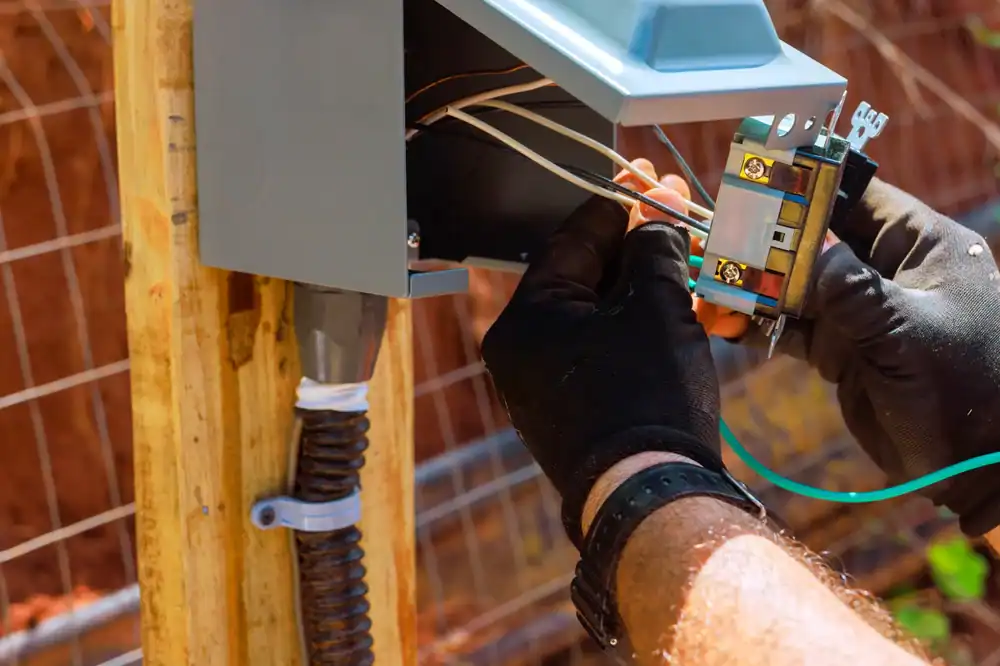
After Winter Storm Uri, "which generator?" became a real question for Tarrant County homeowners. Here's an honest breakdown of what each option actually costs.
Share:

Summary:
Most Tarrant County homeowners don’t start researching generators on a calm Tuesday afternoon. They start after three days without power in February, or after watching a neighbor’s house stay lit through a storm that knocked out their block for a week. You’ve already decided you need backup power. The real question is which kind — and what it’s actually going to cost you. Not the sticker price. The real cost. This guide walks through both options honestly so you can make a decision that holds up the next time the grid doesn’t.
A portable generator is a machine you store in your garage, wheel out during an outage, fill with gasoline, and manually start. A home standby generator is a permanently installed system connected to your home’s natural gas line and electrical panel — one that starts automatically within seconds of a power failure, whether you’re home or not.
That distinction matters more than most people realize. When Winter Storm Uri hit Tarrant County in February 2021, nearly 39% of the county lost power simultaneously. Gas stations ran out of fuel. Roads were impassable. A generator that required a trip to a gas station or manual operation in subzero conditions wasn’t just inconvenient — for many families, it was useless.

For a fully installed home standby generator in Tarrant County, you’re generally looking at $8,500 to $11,000 for a 14kW system, and $13,000 to $18,500 for a 22–26kW unit. That installed price includes the generator itself, the automatic transfer switch, a concrete pad, all electrical and gas connections, and permits.
The size you need depends on what you want to power. A smaller system covers critical circuits — refrigerator, lights, a few outlets, and basic HVAC function. A larger system covers the whole house, including central air, which in a Texas summer isn’t a luxury — it’s a health issue.
Several factors drive the price up or down. If your home already has a natural gas line close to where the generator will sit, the gas connection is straightforward. If it needs to be extended, that adds cost. Homes with older electrical panels sometimes need an upgrade before a transfer switch can be properly installed.
In parts of Tarrant County — particularly in master-planned communities in Keller, Colleyville, and Southlake — HOA setback requirements can affect where the unit goes, which affects the scope of the gas and electrical runs. We work with those restrictions regularly and know how to navigate them.
Permits are required for standby generator installation in Texas, and they aren’t optional. The National Electrical Code requires a properly installed transfer switch, and Texas Property Code Section 202.019 mandates that all electrical, gas, and fuel line connections be made by licensed contractors. We handle the permits, coordinate the inspections, and make sure everything is code-compliant — so the manufacturer warranty stays intact and the system is safe to operate.
Most installations we complete are done in a single day. That’s how a well-coordinated installation goes when the site evaluation is done properly upfront.
Portable generators start around $500 for a basic model, and that price point is genuinely appealing. But the $500 number is the beginning of the cost conversation, not the end of it.
First, there’s the transfer switch. You can’t safely connect a portable generator directly to your home’s wiring — doing so is a fire hazard and can backfeed electricity into utility lines, putting linemen at risk. A proper manual transfer switch adds $500 to $2,000 to the cost. If you skip it and run extension cords instead, you’re not powering your HVAC, your refrigerator compressor, or anything that requires a hardwired connection — which is most of what matters during a multi-day outage.
Then there’s fuel. Portable generators run on gasoline. During Winter Storm Uri, gas stations across Tarrant County ran dry within hours of the outage beginning. If you didn’t have fuel stored before the storm hit, you didn’t have a working generator. Stored gasoline degrades — fuel stabilizer helps, but most manufacturers recommend using stored gas within 30 days without it, and within a year with it. That means ongoing maintenance just to keep the fuel viable.
There’s also the carbon monoxide risk. Portable generators cannot be run indoors or in an attached garage. During a Texas ice storm, running one outside means operating it in dangerous conditions, and every year people die from CO poisoning because they moved a generator inside to escape the cold.
Add up the manual transfer switch, a few years of fuel rotation, the food you lost in the last outage before you had backup power, and the hotel stay during Uri — and the gap between a $500 portable generator and a $10,000 standby system looks considerably different than it did at first glance. That’s before accounting for the fact that a standby generator lasts 15 to 30 years and runs on natural gas that doesn’t run out at a pump.
Tarrant County experienced 4,458,126 customer power outage hours during Winter Storm Uri — the highest of any county in the DFW region. At the peak, 367,964 households were simultaneously without power. That’s not a statistic from somewhere else. That’s your county, your neighbors, and very possibly your street.
The question isn’t whether backup power is worth it in North Texas. Uri already answered that. The question is which backup power solution actually works when you need it — and what you’re willing to spend now versus what you’re willing to risk later.

When someone quotes you a standby generator installation price, that number should include several distinct components — and if a quote doesn’t break them out, that’s worth asking about.
The generator unit itself is one cost. The automatic transfer switch — the device that detects a power failure and switches your home from grid power to generator power without you doing anything — is another. The concrete pad the generator sits on, which Texas code requires to be a minimum of three inches above the surrounding grade, is typically around $1,000. Then there’s the electrical work connecting the transfer switch to your panel, the gas line connection, and the permit fees.
Labor for a standby generator installation in Tarrant County generally runs $3,000 to $5,000, depending on the complexity of the job. Homes in older Fort Worth neighborhoods — places like Fairmount or Handley — sometimes have panel configurations that require more work to integrate a transfer switch cleanly. Newer construction in Keller, Mansfield, or North Richland Hills tends to be more straightforward because the panels and gas infrastructure are already designed for higher loads.
One thing that doesn’t change regardless of where you live in Tarrant County: the installation has to be done by a licensed Texas electrical contractor. That’s not just a legal requirement — it’s what protects your manufacturer warranty. An unlicensed installation can void coverage on a generator that’s supposed to last 20 years. We hold Texas Electrical Contractor License TECL 25420, which means every installation we do is permitted, inspected, and backed by our own labor warranty on top of the manufacturer’s.
That depends on what “worth it” means to you — but here are the honest answers to the questions we hear most often.
Will it actually start when the power goes out? Yes. An automatic transfer switch detects the outage and starts the generator within seconds. You don’t have to be home. You don’t have to do anything. If you’re at work when a storm rolls through and your household includes someone elderly, a young child, or anyone who depends on medical equipment, that automation isn’t a convenience — it’s the whole point.
Can it run my air conditioning? A properly sized standby generator can power your entire home, including central HVAC. A 14kW system covers critical circuits. A 22kW or larger system covers everything. We do a load analysis before any installation to make sure the generator we recommend actually matches what your home needs — not just what fits the average house.
What about my HOA? Many master-planned communities in Tarrant County — particularly in Southlake, Colleyville, and Keller — have restrictions on portable generator operation. Extended outdoor use, noise levels, and fuel storage are all areas where HOA rules can effectively prohibit a portable generator from being your long-term solution. A permanently installed standby unit, properly sited and permitted, is typically the only compliant option in those neighborhoods.
How long does a standby generator last? With regular maintenance, 15 to 30 years. That’s a long horizon over which to amortize a $10,000 to $18,500 installation cost — especially when you consider what another multi-day outage in a Texas summer or winter would actually cost your household.
If you need something cheap and temporary, a portable generator does a job. But if you’re thinking about what happens the next time ERCOT declares a grid emergency — and Texas’s isolated power grid makes that a real possibility, not a remote one — a portable generator running on gasoline that may not be available is a fragile plan.
A home standby generator installed by a licensed electrician, connected to natural gas, and wired with an automatic transfer switch is a different category of protection entirely. It doesn’t ask anything of you when the power goes out. It just works.
We’ve been doing this work in Tarrant County for over 25 years. We pull the permits, handle the inspections, and back every installation with a warranty on both parts and labor. If you’re ready to stop weighing the options and start getting a real answer for your home, reach out to Carroll Service Co. — we’ll tell you exactly what your house needs and what it’ll cost before any work begins.
Article details:
Share:
Continue learning: