Uri changed how Tarrant County homeowners think about power. Here's what that storm taught us — and what to do before the next one hits.
Share:
Summary:
If you were in Tarrant County during Winter Storm Uri, you don’t need anyone to explain why backup power matters. You lived it — no heat for days, pipes threatening to burst, a refrigerator full of food you couldn’t save, and the realization that the grid you’d always taken for granted had simply stopped working. What’s harder to know is whether things have actually changed since then, and whether a whole home generator installation is still worth it. We’ve put together this guide to give you a straight answer — no fear-mongering, no sales pitch upfront — just the information you need to make a smart decision for your home.
Uri wasn’t just a bad storm. It was a stress test the Texas grid failed in real time. At peak, roughly 4.5 million households — around 10 million Texans — lost power, some for multiple consecutive days. ERCOT, the entity that manages the Texas grid, came within minutes of a total uncontrolled collapse. Thirty gigawatts of generation capacity went offline simultaneously, and demand exceeded ERCOT’s projected winter peak by more than 10,000 megawatts.
Fort Worth and the surrounding Tarrant County communities were hit hard. The failures weren’t caused by an unusual weather pattern alone — they were caused by a natural gas supply chain that hadn’t been built to handle extreme cold, feeding a grid that had no way to import power from neighboring states. Texas runs its own isolated grid. When it struggles, it struggles alone.
That combination — extreme weather, isolated grid, gas-dependent generation — is still in place today. And that’s the part worth understanding before you decide whether a standby generator is right for your home.
This is the question we hear most often, and it deserves a real answer rather than a vague one. Yes, Texas has made meaningful improvements since Uri. Mandatory weatherization standards now apply to power generators. ERCOT operates with higher reserve margins. Load-shedding protocols have been enhanced to prevent a repeat of the cascading failure that nearly took the entire grid offline.
But here’s what those reforms don’t change: natural gas still supplies more than 50% of Texas electricity generation. The grid remains isolated from neighboring states, which means Texas still cannot import significant power during a crisis the way most of the country can. And demand is growing — faster than new generation capacity is being added. The population of Tarrant County alone has grown substantially in recent years, and that growth puts ongoing pressure on a system that was already stretched thin.
The reforms reduce the risk of another Uri-scale event. They don’t eliminate it. And they do nothing to protect your home from the more routine outages — severe thunderstorms in the spring, ice storms in January, summer heat events that push the grid to its limits. If you’ve experienced even one multi-day outage, you already know that “the grid is better” isn’t the same as “the grid is reliable.”
For Tarrant County homeowners, the honest calculus is this: the improvements are real, but so is the ongoing exposure. A whole home generator installation isn’t a response to a past disaster — it’s a hedge against a grid that, by its own structure, will continue to face pressure.
One more thing worth knowing: home standby generator installations in Texas grew 150% year-over-year following Uri. That’s not panic buying. That’s a lot of homeowners reaching the same conclusion after thinking it through.
If you rode out Uri with a portable generator, you already know its limitations. You had to drag it out, fuel it up, run extension cords, and manage the whole operation manually — all while it was freezing outside. Portable generators can’t power an entire home, they require constant attention, and they create real carbon monoxide risks if used anywhere near the house.
A home standby generator is a fundamentally different product. It’s permanently installed outside your home — typically on a concrete pad — connected directly to your home’s electrical panel through an automatic transfer switch. When the grid goes down, the transfer switch detects the outage and starts the generator automatically within seconds. You don’t have to do anything. If you’re asleep, if you’re away, if you’re elderly and can’t easily get outside in the cold — it doesn’t matter. The generator starts on its own and your home keeps running.
For most Tarrant County homes, a natural gas standby generator is the most practical option. Most homes in the area are served by Atmos Energy’s natural gas distribution network, which means the generator connects directly to your existing gas line. There’s no propane tank to refill, no diesel to store, and no fuel shortage to worry about during a crisis when gas stations are also without power. Natural gas infrastructure has generally proven more resilient than the electrical grid during weather events — during Uri, gas lines continued flowing in many areas even as the electrical grid collapsed, though supply was disrupted in some locations as well.
A properly sized standby generator can power your entire home — heating and cooling, refrigerator, lights, medical equipment, security systems — for as long as the outage lasts. Units can run up to approximately 500 hours continuously, which is roughly three weeks. That’s a different category of protection than anything a portable unit can offer.
Cost is usually the first real question, and it’s a fair one. For a turnkey whole home generator installation in Tarrant County — meaning the generator itself, the automatic transfer switch, the concrete pad, gas line connections, electrical connections to your panel, permits, city inspection, and startup — the range runs from approximately $7,000 to $20,000, with most jobs landing somewhere in the middle.
The wide range reflects real variables: the size of your home, how much of it you want the generator to power, and whether your existing electrical panel can support the system without upgrades. A 22kW air-cooled unit is a common specification for a mid-size Tarrant County home around 2,500 square feet, and it handles the full load most families need.

This is something a lot of homeowners don’t find out until they’re already in the process, and it’s worth knowing upfront. Many older homes in Fort Worth and throughout Tarrant County — particularly those built in the 1960s, 1970s, and 1980s — were wired with 100-amp electrical panels. That was standard for the time, but it’s often not sufficient to support a modern whole-home standby generator without creating problems.
A standby generator connects to your home through an automatic transfer switch, which ties directly into your electrical panel. If your panel is already operating near capacity — which older 100-amp panels often are, given how much more electricity modern homes consume compared to when those panels were installed — adding a generator to the system can overload it. In some cases, a panel upgrade is a prerequisite for a proper, code-compliant generator installation.
This isn’t a sales tactic. It’s a practical reality that affects a meaningful portion of the Fort Worth housing stock. Homes in established neighborhoods throughout Tarrant County — places that were built out decades before smart TVs, EV chargers, and high-draw HVAC systems were common — are frequently running on electrical infrastructure that wasn’t designed for today’s demands, let alone a whole-home backup power system layered on top.
The right approach is a proper load calculation before any generator is sized or ordered. That calculation tells you exactly what your home draws, what size generator you actually need, and whether your current panel can handle the connection. If it can’t, knowing that upfront saves you from a costly surprise mid-project. It also means the installation gets done correctly the first time — permitted, inspected, and built to last.
One of the most common sources of anxiety for homeowners considering a generator is not knowing what they’re signing up for. The process involves more steps than most people expect, and understanding them upfront makes the whole experience less stressful.
It starts with a site evaluation — assessing your home’s electrical load, determining the right generator size, and identifying the best placement for the unit. Generator placement isn’t arbitrary. Code requires that generators be positioned at least five feet from windows, doors, and vents, and the unit needs to sit on a concrete pad, which is typically installed as part of the project.
From there, the installation involves connecting the generator to your home’s natural gas line, running the electrical connections from the generator to your panel, and installing the automatic transfer switch. The ATS is the component that makes the whole system work automatically — it monitors the grid, detects an outage, signals the generator to start, and transfers your home’s electrical load over within seconds. When utility power is restored, it switches back and shuts the generator down. You never have to touch it.
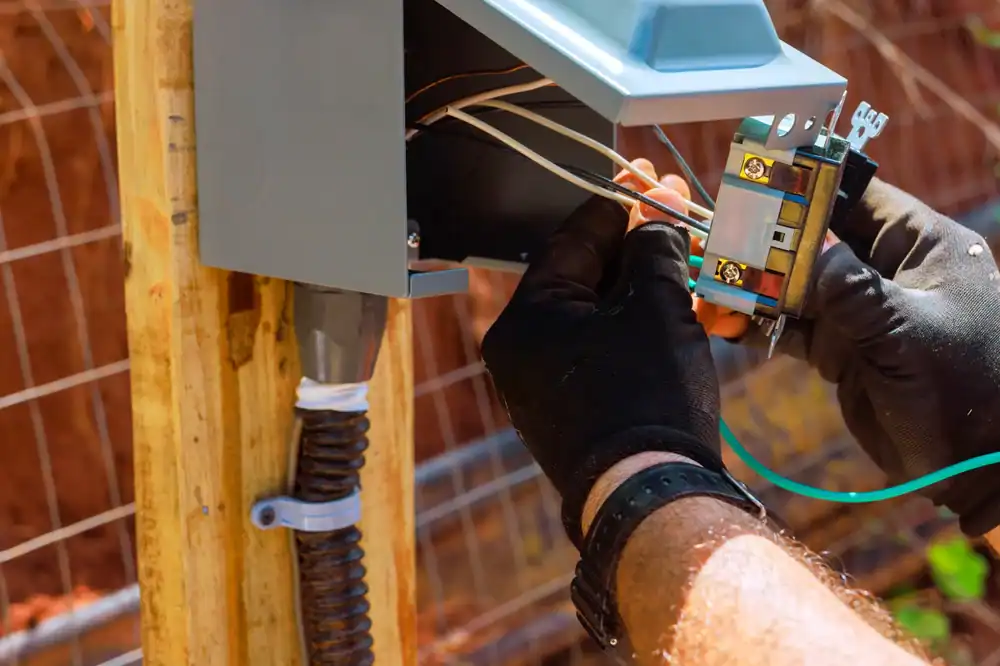
Permits are required for generator installations in virtually all Tarrant County municipalities, and they exist for good reason. An improperly installed transfer switch can create a dangerous backfeed condition — sending electricity back onto the utility lines while workers are trying to restore power. Licensed electrical contractors pull permits, schedule city inspections, and make sure the installation meets code. That’s not optional, and it’s not a bureaucratic inconvenience — it’s what separates a safe installation from a liability.
The physical installation typically takes one to two days. The full project timeline — from ordering the unit through permitting, installation, and final inspection — can take several weeks, which is why homeowners who want a generator in place before the October-November freeze season in North Texas are better served by starting the process in early fall rather than waiting for the first cold snap.
Uri was a wake-up call. The grid improvements since then are real, but the underlying exposure — an isolated Texas grid, natural gas dependency, growing demand — hasn’t fundamentally changed. For Tarrant County homeowners who’ve been through a multi-day outage and don’t want to go through another one, a whole home generator installation is one of the most practical decisions you can make for your home.
The process is more involved than most people expect, which is exactly why it matters who does the work. Proper sizing, panel evaluation, code-compliant installation, permits, city inspection — these aren’t details to rush through or skip.
We’ve been installing generators throughout Tarrant County for over 25 years. We’re licensed under TECL 25420, hold an A+ BBB rating, and have earned multiple Angie’s List Super Service Awards — but more than any of that, we’re a local, family-owned business that’s been through the same Texas weather events as our customers. If you’re ready to have a straightforward conversation about what your home actually needs, we’re here.
Article details:
Share:
Continue learning: