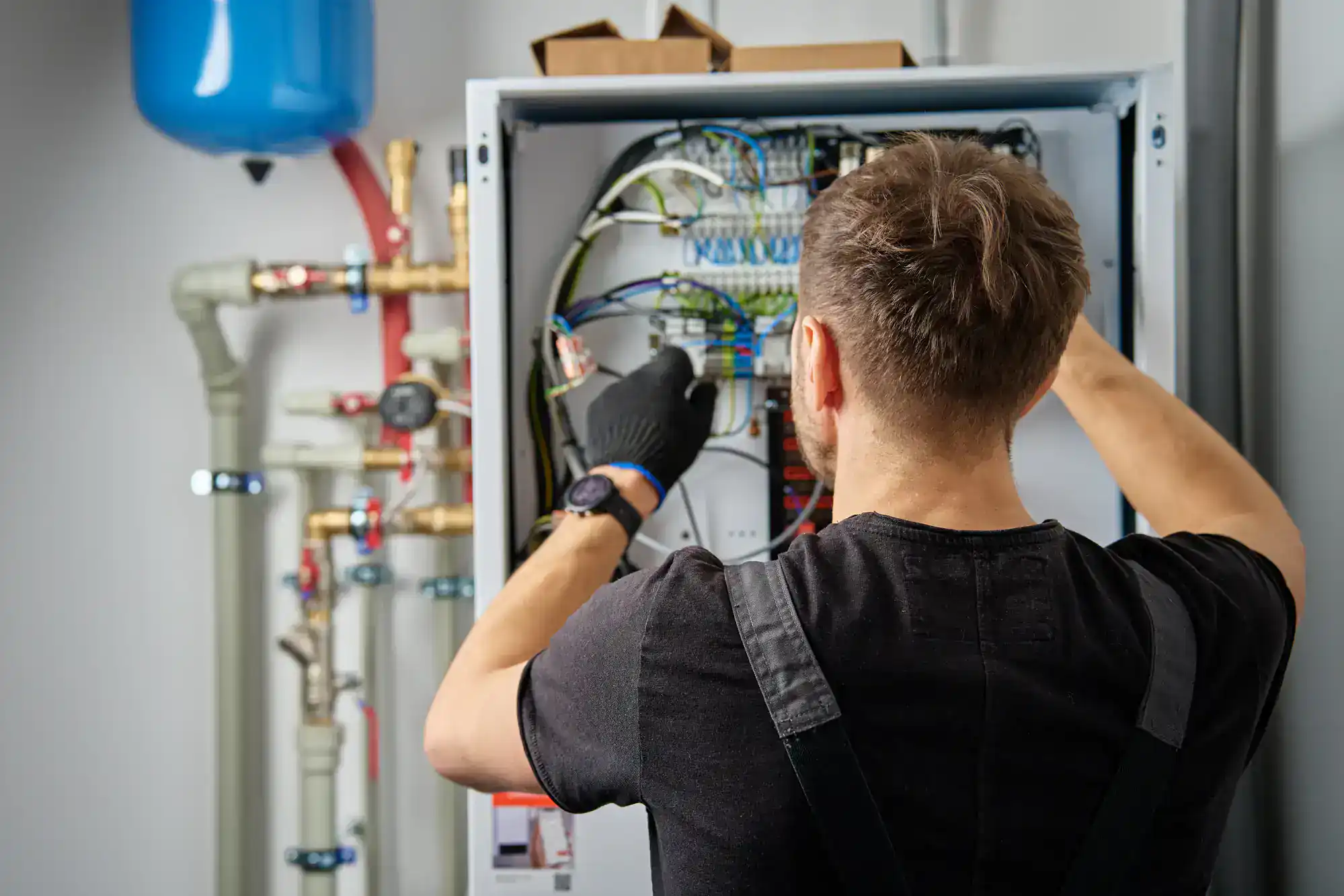
From a loose bulb to a failing panel, flickering lights can mean a lot of different things. Here's how to tell the difference.
Share:

Summary:
Most homeowners notice flickering lights and do one of two things: change the bulb, or decide to worry about it later. Sometimes that’s the right call. But sometimes it isn’t, and the tricky part is that the symptom looks the same whether the cause is a $4 bulb swap or a loose wire slowly generating heat inside your wall.
This isn’t a page designed to scare you into calling an electrician. It’s designed to help you figure out what you’re actually dealing with — so you can make a smart decision about whether to fix it yourself, schedule a visit, or pick up the phone right now.
The least dramatic explanation is usually a loose bulb, a worn lamp socket, or a dimmer switch that isn’t compatible with your LED bulbs. LED bulbs are sensitive to fluctuations in power supply, and many of them require a specific type of dimmer to operate correctly. If you’ve swapped incandescent bulbs for LEDs but kept the old dimmer, flickering is almost guaranteed — and it has nothing to do with your wiring.
A light that flickers only in one fixture, only when you use a specific lamp, or only after you recently changed bulbs is almost always pointing to one of these minor causes. Tighten the bulb, check the plug, or swap the dimmer for one rated for LEDs. If the flickering stops, you’re done.
The situation gets more interesting — and more serious — when the flickering doesn’t stop, when it’s happening in multiple rooms, or when it kicks in every time a large appliance turns on.

This is one of the most common things homeowners notice, and it catches a lot of people off guard. You start a load of laundry, and the lights in the kitchen or hallway dim for a second before coming back. It happens with the AC too, and sometimes with the refrigerator when the compressor kicks on.
What’s happening is called inrush current. When a large motor starts up — like the one in your washing machine or HVAC system — it briefly draws a much higher amount of electricity than it uses during normal operation. That sudden spike in demand causes a momentary voltage drop across the circuit, and your lights respond by dimming or flickering for a second.
A very brief, one-second dip when a large appliance starts is within the range of normal. The electrical system is doing what it’s supposed to do — handling a surge and recovering quickly. Most homeowners in newer homes with properly sized panels won’t give it a second thought.
But here’s where it gets important. If the dimming lasts more than a second or two, if it’s happening on circuits that aren’t even connected to the appliance, or if it’s getting more noticeable over time, that’s your panel telling you it’s working harder than it should be. Tarrant County has a significant number of homes — particularly in older Fort Worth neighborhoods like Fairmount and the Historic Southside, and in the inner-ring suburbs built in the 1970s and 80s — where the original panels were sized for the electrical loads of that era. Those loads have grown considerably since then. More HVAC zones, home offices, EV chargers, smart home systems — all of it adds up. A 100-amp panel that was adequate in 1985 may be genuinely strained today, and appliance-triggered flickering is often the first sign that the system is approaching its limits.
If your lights are dimming every time the washer or AC kicks on and the dip is noticeable or prolonged, it’s worth having us look at the panel — not because it’s definitely failing, but because that’s the only way to know for sure what’s happening.
A loose neutral wire is one of the more serious causes of flickering lights, and it’s also one of the least understood. Most homeowners have never heard the term, which is part of why it goes undiagnosed longer than it should.
Here’s the short version of how it works. Your home’s electrical system runs on two hot legs and a neutral wire that balances the load between them. When the neutral connection is solid, the system stays in balance. When it’s loose — whether at the panel, at the service entrance, or somewhere along the circuit — that balance breaks down. One leg of the circuit can end up carrying too much voltage while the other carries too little. The result is lights that flicker or dim unpredictably, sometimes in patterns that don’t seem to correspond to anything obvious.
What makes a loose neutral genuinely dangerous isn’t just the flickering. It’s what’s happening electrically while the flickering occurs. The imbalance creates conditions where appliances connected to the affected circuits can receive voltage they weren’t designed to handle. Sensitive electronics — TVs, computers, anything with a circuit board — are particularly vulnerable. More seriously, the loose connection itself generates heat. Electrical connections that arc or run hot inside walls or panels can degrade insulation over time, and that’s how electrical fires start — not dramatically, but slowly, invisibly, over weeks or months.
One of the telltale signs of a loose neutral is flickering that seems to affect different fixtures at different times, or lights that brighten in one part of the house while dimming in another. If you’ve noticed that pattern, or if your lights flicker even when no large appliances are running, a loose neutral is worth putting on the list of possibilities.
This isn’t a DIY diagnosis. Tracking down a loose neutral requires tracing the neutral connection from the panel through the branch circuits, and working inside a live panel is not something to take on without proper training and equipment. In Texas, electrical work inside the panel requires a licensed contractor — we hold Texas Electrical Contractor License TECL 25420, which is verifiable through the Texas Department of Licensing and Regulation.
The honest answer is: not directly, but the conditions that cause certain types of flickering absolutely can. A loose bulb won’t start a fire. An incompatible dimmer won’t start a fire. But loose wiring, deteriorating connections, and electrical arcing — all of which can produce flickering as a symptom — are a different matter entirely.
When a connection is loose or corroded, electrical current has to work harder to pass through it. That resistance generates heat. Over time, that heat builds up in places you can’t see — inside wall cavities, behind outlet boxes, in the panel itself. The insulation around the wires degrades. Arcing can occur, where current jumps across a gap between conductors and generates intense heat in a fraction of a second. That’s how electrical fires start, and it’s why flickering lights that don’t have an obvious innocent explanation deserve more than a wait-and-see approach.

Context matters a lot here, and the context in Tarrant County is specific. A meaningful portion of the housing stock in this area — particularly in Fort Worth’s older neighborhoods and the suburbs that developed rapidly in the 1970s and 80s — has electrical systems that are now 40 to 60 years old. Wiring degrades. Connections loosen over time, especially on circuits that run through exterior walls where temperature swings between a Texas summer and a Texas winter cause materials to expand and contract repeatedly over decades.
The outdoor outlets on the exterior walls closest to your service panel are a good example. Those outlets carry the full current of the circuit, and they’re subjected to the widest temperature variations in the house. Over time, the wire connections at those junctions can work themselves loose — and a loose connection in series with a live circuit is a heat source. It may not produce any visible sign for a long time. The flickering, when it finally appears, is often the first indication that something has been quietly degrading.
Summer in North Texas makes this worse. When temperatures stay above 100°F for extended periods and HVAC systems run continuously, the electrical system is operating near its upper limits for weeks at a time. Homes with aging panels, loose connections, or circuits running close to capacity are under the most stress during those stretches. That’s not a hypothetical — it’s the pattern we see every summer in Tarrant County homes.
The clearest warning signs that flickering may indicate a fire risk rather than a nuisance are flickering that’s getting more frequent over time, flickering accompanied by a burning smell or discoloration around outlets or switches, lights that flicker throughout the whole house rather than in one fixture or room, and any flickering that occurs even when no large appliances are running and no obvious cause is present. If any of those apply to your situation, the right move is to call us — not next week, but today.
**Is it normal for lights to dim when the AC kicks on?**
A very brief, momentary dip — lasting less than a second — is common and generally not a cause for concern. Large motors draw more current at startup, which creates a short voltage drop on the circuit. If the lights recover quickly and the dimming is subtle, your system is likely handling it within normal parameters. If the dip is noticeable, lasts more than a second or two, or is happening more often than it used to, it’s worth having the panel evaluated. In Tarrant County, where summer heat keeps HVAC systems running almost continuously for months at a time, panels that are undersized or aging can show this kind of stress earlier and more often than in milder climates.
**Why do my lights flicker throughout the whole house — not just in one room?**
Whole-house flickering is a different category of concern than a single flickering fixture. When it’s isolated to one light or one room, the cause is usually local — a bulb, a socket, a switch, or a dimmer. When it’s happening throughout the house, the problem is more likely upstream: at the panel, at the service entrance, or at the utility connection. A loose neutral wire is one of the most common causes of whole-house flickering, and it’s one of the more serious ones. Utility-side voltage fluctuations can also cause this, but the utility company is only responsible for the line up to your meter — everything from the meter into the house is yours.
**Should I call an electrician for flickering lights, or can I handle it myself?**
It depends entirely on the symptom. If it’s a single fixture and the bulb is loose or incompatible with the dimmer, handle it yourself. If it’s multiple fixtures, if it’s triggered by large appliances and getting worse, if it’s accompanied by any smell, warmth, or discoloration near outlets or the panel — call us. In Texas, any work inside the panel requires a contractor with a valid TECL license. We hold TECL 25420 and have been serving Tarrant County homes for over 25 years. Our service call fee is $75, and we’re upfront about pricing before any work begins — no surprises after the fact.
**Could my flickering lights be the utility company’s problem?**
Possibly, but it’s less common than homeowners assume. Utility-side voltage fluctuations do happen and can cause lights to flicker or dim across the whole house. If your neighbors are experiencing the same thing at the same time, that’s a strong indicator it’s on the utility’s end. But the utility is only responsible for the line up to your meter. If the flickering is isolated to your home, the cause is almost certainly inside your system.
Flickering lights exist on a spectrum. On one end, you have a loose bulb or a dimmer that was never rated for LEDs — minor, easy, done in five minutes. On the other end, you have a loose neutral wire or aging wiring that’s generating heat inside your walls right now. The frustrating part is that both can look identical from where you’re standing.
The practical rule is this: if you can identify a clear, simple cause and the flickering stops when you address it, you’re fine. If you can’t explain it, if it’s getting worse, if it’s happening throughout the house, or if anything smells warm or looks discolored near your outlets or panel — don’t wait on it.
We’ve been diagnosing and repairing electrical issues in Tarrant County homes for over 25 years. If you’re not sure what you’re dealing with, that’s exactly the kind of question we’re here to answer.
Article details:
Share:
Continue learning: