Everything Tarrant County homeowners need to know about home EV charger installation — costs, panel requirements, permits, and what to watch out for.
Share:
Summary:
You bought the car. Now you’re realizing the outlet in your garage isn’t going to cut it. That standard 120-volt outlet — the one you’ve been plugging into every night — adds maybe four or five miles of range per hour. If your EV has a 300-mile range, you’re looking at two or three days to fully charge from empty. That’s not a charging solution. That’s a slow inconvenience. The good news is that a proper Level 2 home EV charger installation changes everything. Here’s what you actually need to know before picking up the phone — including what it costs, what can go wrong, and what makes a Tarrant County home different from the rest.
Not all home charging is the same, and the difference matters more than most people realize. A Level 1 setup uses your standard household outlet — no installation required, but painfully slow. A Level 2 home car charging point runs on a dedicated 240-volt circuit, the same type of circuit your dryer or range uses, and delivers 20 to 30 miles of range per hour. That’s four to ten times faster than Level 1.
For most Tarrant County commuters, Level 2 is the only option that makes daily driving practical. If you’re running errands, commuting on SH-121 or SH-114, and coming home with 40 miles of range burned off, you need a charger that can recover that overnight — not over three days.

When it comes to choosing an electric car charger for your home, you’ll run into two main installation types: a hardwired charger mounted directly to your wall, or a plug-in unit that connects to a NEMA 14-50 outlet. Both require a licensed electrician to install the dedicated 240-volt circuit — the difference is just how the charger attaches at the end.
Plug-in setups using a NEMA 14-50 outlet are popular because they’re portable. If you move, you take the charger with you. Hardwired units are more permanent but often offer higher amperage output, which means faster charging. For most homeowners in Keller, Southlake, or Colleyville with an attached garage and no plans to move in the next few years, a hardwired Level 2 charger is the cleaner, more capable choice.
The charger hardware itself — the unit that mounts to your wall — is separate from the electrical work. Equipment from brands like ChargePoint or the Tesla Wall Connector typically runs a few hundred dollars on its own. The installation cost, which includes running the dedicated circuit from your panel, is where the real variation comes in. More on that in a moment.
One thing worth knowing: the onboard charger in your vehicle sets the ceiling for how fast it can accept power. A car with a 7.2 kW onboard charger won’t charge any faster just because you install a 48-amp unit. Matching the charger output to what your vehicle can actually use is part of a good installation assessment — and it’s something we walk through with every customer before recommending a unit.
Tesla owners have a specific question that comes up constantly: do I need a Tesla Wall Connector, or can I just use a NEMA 14-50 outlet? The honest answer is that either can work, but they’re not equal.
A NEMA 14-50 outlet gives you flexibility — you can use Tesla’s mobile connector or a third-party Level 2 charger with an adapter. A Tesla Wall Connector, hardwired directly to a dedicated 240-volt circuit, delivers faster charging speeds and integrates more cleanly with the vehicle’s software. For a Model 3 or Model Y owner who drives 50 or more miles a day, the Wall Connector is typically the better long-term investment.
The cost to install a 240V outlet for a Tesla — whether that’s a NEMA 14-50 or a hardwired Wall Connector — depends heavily on how far the circuit needs to run from your electrical panel and whether your panel has the capacity to support it. In homes built in the 1980s and 1990s, which are common throughout northern Tarrant County in areas like Trophy Club and North Richland Hills, 100-amp panels are still the norm. A Level 2 charger typically needs a 30 to 60-amp dedicated circuit, and a 100-amp panel that’s already carrying a full load of appliances may not have room for it without an upgrade.
Wall connector installation cost varies, but the full project — circuit, permit, labor, and the Wall Connector unit itself — generally falls somewhere in the range we quote for EV charger installation: $800 to $2,500, depending on your home’s existing electrical setup and where you want the charger mounted. If a panel upgrade is part of the picture, that’s a separate conversation with its own cost range.
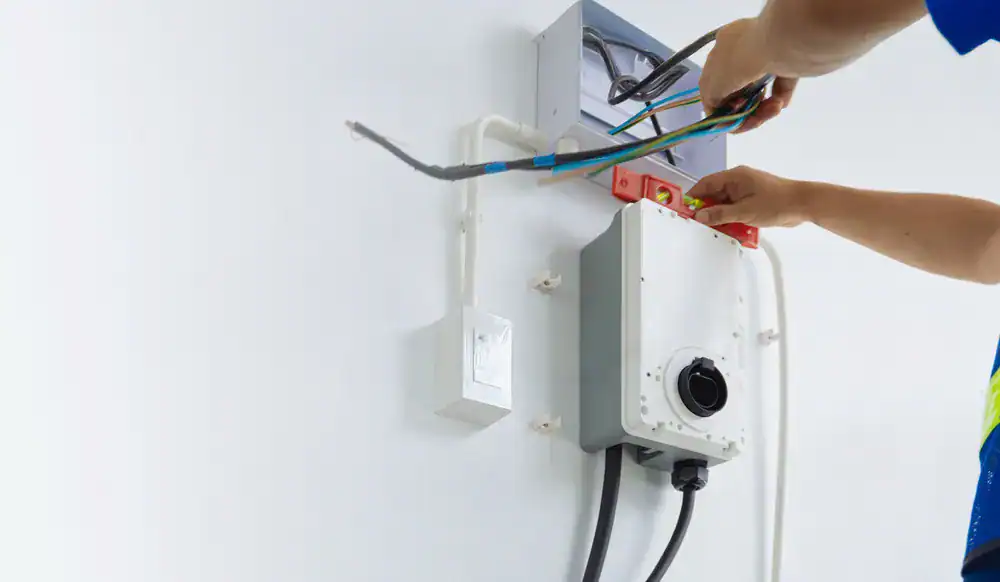
Installing a Level 2 EV charger isn’t complicated when your home is ready for it. We run a dedicated 240-volt circuit from your electrical panel to the garage, install the outlet or hardwired connection, mount the charger, and pull the required permit. The inspection happens after the work is done, and once it passes, you’re charging.
The part most homeowners don’t anticipate is the permit requirement. In Tarrant County, any new circuit installation requires a permit from the city’s building department — and each city has its own process. Keller, Fort Worth, Southlake, and Roanoke all have separate permit offices. We handle that process for every job, so you’re not chasing paperwork.

This is the question that catches the most homeowners off guard. You call an electrician expecting a straightforward charger install, and we come back telling you that your panel needs to be upgraded first. It feels like an upsell. Sometimes it genuinely is. But in northern Tarrant County, it’s often a real issue.
Many homes in Keller, Trophy Club, North Richland Hills, and Colleyville were built in the 1980s and 1990s with 100-amp electrical panels. At the time, that was plenty. Today, those same panels are running central air conditioning, electric ranges, water heaters, dishwashers, and a full load of modern electronics. A Level 2 EV charger draws 30 to 60 amps on a dedicated circuit. When a 100-amp panel is already near capacity, there’s simply no room to add it safely.
The way to know for certain is a load calculation — a straightforward assessment of how much power your panel is currently carrying versus how much capacity it has left. We do this before quoting any EV charger installation, because there’s no point in giving you a number until we know what your home actually needs. If your panel has room, we install the circuit and move on. If it doesn’t, we’ll tell you what a panel upgrade would cost and what it involves before you make any decisions.
Home EV charger installation cost in Tarrant County varies more than most people expect, and the range is wide enough that a single number wouldn’t tell you much. For a straightforward installation — panel has capacity, garage is close to the panel, no major circuit runs needed — the cost typically falls between $800 and $2,500. That includes the electrical work, the permit, and labor. The charger unit itself is separate.
What drives the cost toward the higher end? Distance from the panel to where you want the charger mounted is a big one. If your garage is on the opposite end of the house from your electrical panel, the circuit run is longer and more labor-intensive. Conduit requirements, the amperage of the circuit, and local permit fees all factor in as well.
When it comes to EV outlet installation cost specifically — meaning a NEMA 14-50 outlet rather than a hardwired unit — the electrical work is essentially the same. You’re still running a dedicated 240-volt circuit from the panel. The outlet itself just gives you the option to plug in rather than hardwire.
One thing that can meaningfully offset the total: Texas utility rebates. Many Texas utility companies, including Oncor Electric Delivery, which serves most of Tarrant County, offer rebates of $250 to $1,200 for EV charger installation. On top of that, a federal tax credit covers 30% of the installation cost, up to $1,000, and it’s available through 2032. If you’re budgeting for this project, those programs are worth factoring in — they can make a real dent in the out-of-pocket number.
A note on Level 3 charging: DC Fast Charging (Level 3) requires 480-volt three-phase power, which is industrial infrastructure not available in residential settings. It’s not a home option.
Flickering lights in one room, lights that dim when the HVAC kicks on, breakers that trip more than they should — these aren’t random quirks. They’re often signs of an overloaded circuit, a loose neutral, or a panel that’s already at its limit. Adding a Level 2 EV charger to a home with those symptoms without addressing the underlying issue first isn’t just a bad idea. It’s a safety risk.
A loose neutral connection creates voltage imbalances that generate heat at the connection point. That heat, over time, can damage wiring insulation and create a fire hazard. It’s one of the reasons we assess the full electrical system before any EV charger installation — not to find more work, but to make sure the work we do actually holds up.
If you’re in Tarrant County and you’re ready to move past the slow-charge frustration, we’ve been handling exactly this kind of work in DFW homes for over 25 years. Give us a call at the discounted service call rate of $75 — and we’ll start with an honest assessment of what your home actually needs.
Article details:
Share:
Continue learning: