Just got an EV and wondering what comes next? Here's the honest breakdown of home car charger installation for Tarrant County drivers.
Share:
Summary:
You drove your new EV home, pulled into the garage, and plugged it into the wall outlet. Then the app told you it would be fully charged in 47 hours. That’s usually when it hits people.
A standard 120-volt outlet — the kind every garage already has — isn’t built for daily EV charging. It works, technically. But for most Tarrant County drivers covering 30 or 40 miles a day, it barely keeps pace with what you’re using. This guide walks you through what home car charger installation actually involves, what questions to ask before you hire anyone, and what’s different about doing this in Tarrant County versus anywhere else in the country.
The outlet in your garage is a Level 1 charger. It runs on 120 volts and adds roughly 3 to 5 miles of range per hour. For someone driving 10 miles a day, that’s probably fine. For most people, it isn’t.
A Level 2 charger runs on 240 volts — the same type of circuit your dryer or range uses — and can fully charge most EVs overnight. We’re talking 4 to 8 hours for a typical battery pack, compared to 40 or 50 hours on a standard outlet. That’s not a small difference. It’s the difference between waking up to a full charge every morning and rationing your driving because you couldn’t charge fast enough overnight.
Level 3, or DC fast charging, is what you see at commercial charging stations. It’s not a residential option — the infrastructure cost and energy demand make it impractical for a home, and frequent use of DC fast charging degrades your battery faster than Level 2 home charging does.

When most people picture a home EV charger, they’re thinking of a wall-mounted unit in the garage — and that’s usually exactly what gets installed. But there’s more going on behind the wall than most homeowners realize.
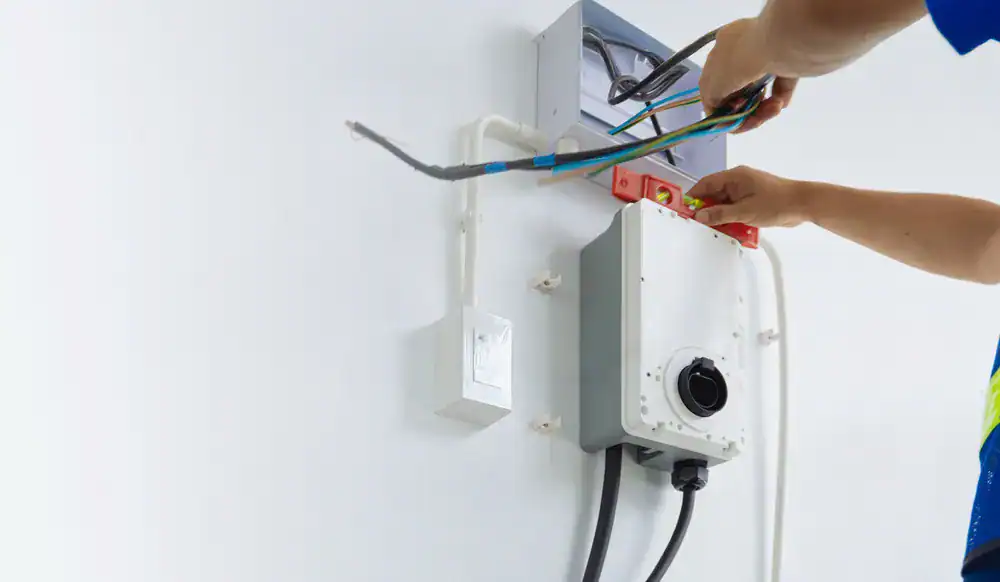
A Level 2 installation starts at your electrical panel. A licensed electrician runs a dedicated 240-volt circuit — meaning this circuit exists solely to power the charger, nothing else shares it — from your panel to the charger location. The wiring is typically 6 AWG copper on a 50-amp breaker, which is the standard for most Level 2 chargers on the market. The charger unit itself is mounted on the wall, usually near where you park, and the cable is managed cleanly so it’s not dragging across the floor.
If your charger is going outside — say, in a covered carport or on an exterior wall — the installation also needs to account for weatherproofing. In Tarrant County, that means equipment rated to handle both the summer heat and the occasional ice storm. Texas weather is not gentle on electrical equipment, and a charger installed without proper weatherproofing is a problem waiting to happen.
There’s also the question of hardwired versus plug-in. A hardwired charger is connected directly to the circuit — no outlet in between. A plug-in charger uses a NEMA 14-50 outlet, which gives you the flexibility to swap out the charger later without rewiring. Both are valid options, and which one makes more sense depends on your setup, your charger brand, and whether you’re planning to move or upgrade equipment down the road. We’ll walk you through both options before recommending one.
One thing worth knowing: the permit for this work is not optional. In Fort Worth, Keller, Southlake, Arlington, and virtually every other Tarrant County municipality, adding a new 240-volt circuit requires a permit and a city inspection. That’s not bureaucratic hassle for its own sake — it’s what ensures the work is done safely and documented for your homeowner’s insurance and any future home sale. Any electrician who suggests skipping the permit is not someone you want working in your home.
This is the question that catches a lot of Tarrant County homeowners off guard, and it’s worth getting ahead of before you call anyone.
A Level 2 EV charger typically draws 30 to 60 amps, depending on the model. If your home has a 100-amp electrical panel — which is common in homes built through the 1980s and into the 1990s across much of Tarrant County — there may not be enough available capacity to support a dedicated EV circuit alongside your HVAC system, kitchen appliances, water heater, and everything else already on the panel. Modern homes generally need 200-amp service to handle today’s electrical loads comfortably, and adding an EV charger to an already-strained 100-amp panel is a real concern.
That said, a panel upgrade isn’t always necessary. Some homes have more headroom than the owner realizes. The only way to know for sure is a proper panel assessment before any work begins. We look at your current panel, identify the available amperage, check for open breaker slots, and give you an honest answer — not an automatic upsell.
In our experience serving Tarrant County homes for over 25 years, we’ve seen the full range — from newer builds in the Alliance corridor with plenty of panel capacity and even pre-run conduit for EV charging, to established neighborhoods in North Richland Hills and Hurst where the panel hasn’t been touched since the house was built. Knowing the local housing stock matters here. It’s not just about running a wire; it’s about understanding what you’re working with before you start.
Home EV charging looks a little different in North Texas than it does in, say, Seattle or Denver. The climate, the commute distances, and the utility structure all factor into what you actually need from a home charging setup.
DFW summers routinely push past 100 degrees, and EV batteries are temperature-sensitive. When the thermal management system in your car works overtime to keep the battery cool in extreme heat, it draws power — which means your real-world range in August is going to be shorter than the EPA estimate suggests. Starting every day with a full charge isn’t a luxury in this climate. It’s a practical necessity.
The commute distances compound this. Tarrant County is a big place, and a lot of residents are driving 30, 40, or more miles each way to employment centers across the Metroplex. That kind of daily mileage makes Level 1 charging essentially unworkable for most households.

The charger market has gotten crowded fast. ChargePoint, JuiceBox, Emporia, Wallbox, Tesla Wall Connector — there are real differences between them, and which one is right for you depends on your car, your panel, your garage setup, and whether you want smart features like scheduling and energy monitoring.
Most Level 2 chargers use the J1772 connector, which is the standard for non-Tesla EVs. Tesla vehicles use their own connector format, though they can charge on J1772 with an adapter, and the Tesla Wall Connector is a popular choice for Tesla owners who want a purpose-built solution. Starting in 2023, the North American Charging Standard (NACS) — Tesla’s connector format — was adopted by several major automakers, so the connector landscape is shifting. Worth confirming compatibility before you buy hardware.
On the smart features side: if you’re on Oncor’s service territory — which covers most of Tarrant County — there are time-of-use rate structures that reward you for charging during off-peak hours, typically overnight. A charger with built-in scheduling lets you set it and forget it, automatically charging during the cheapest hours without you having to think about it. Over time, that can meaningfully offset the increase in your electric bill from charging at home.
It’s better to have the panel assessment done before you commit to a specific charger, because the right charger for your car may not be the right charger for your electrical setup. Getting the assessment first means you’re choosing equipment that actually fits your home.
A lot of homeowners don’t know what a legitimate installation actually looks like, which makes it hard to know whether the person you hired is doing it right. Here’s the honest version.
It starts with an assessment. Before any work begins, we look at your panel, confirm available capacity, identify where the circuit will run, and discuss charger placement with you. This is also when you’d learn whether a panel upgrade is needed and what that would involve. There should be no surprises after this conversation.
Then comes the permit. In Tarrant County, we pull the permit with the local building authority — Fort Worth, Keller, Southlake, Arlington, wherever you are. This is our responsibility, not yours. You shouldn’t have to navigate the city building department yourself. The permit is filed, and work can begin once it’s approved, which typically doesn’t take long for a straightforward residential job.
The installation itself involves running the dedicated circuit from your panel to the charger location, mounting the charger unit, completing all connections, and doing a full test before we leave. Cable management — making sure the cord is routed cleanly along the wall rather than hanging loose — is part of the job, not an afterthought.
After installation, the city inspector comes out to verify the work meets code. This is a routine step, not a red flag. It’s the process working as intended. Once the inspection passes, you’re done — and you have documentation that the installation is code-compliant, which matters for your homeowner’s insurance and for any future buyer if you sell the home.
The whole process, from assessment to inspection, typically moves quickly when you’re working with a contractor who knows the local permitting process. We’ve been doing this in Tarrant County for over 25 years, which means we know how the process works in each municipality and what to expect at each step. That local familiarity makes a real difference in how smoothly the job goes.
Home car charger installation isn’t complicated when you know what you’re walking into. The short version: Level 2 is the practical choice for most Tarrant County households, the panel assessment comes first, permits are non-negotiable, and the right electrician will walk you through all of it before anything gets started.
What separates a good installation from a bad one isn’t the charger brand or the wall mount — it’s whether the person doing the work understands your home’s electrical system, pulls the proper permits, and installs everything to code. In Tarrant County, where a significant portion of the housing stock was built before modern electrical loads were even a consideration, that expertise matters.
If you’re ready to move forward — or just want to know whether your panel can handle it before you commit to anything — Carroll Service Co is happy to take a look. We’re based in Keller, TX, we’ve been serving Tarrant County homeowners for over 25 years, and we’ll give you a straight answer before any work begins.
Article details:
Share:
Continue learning: