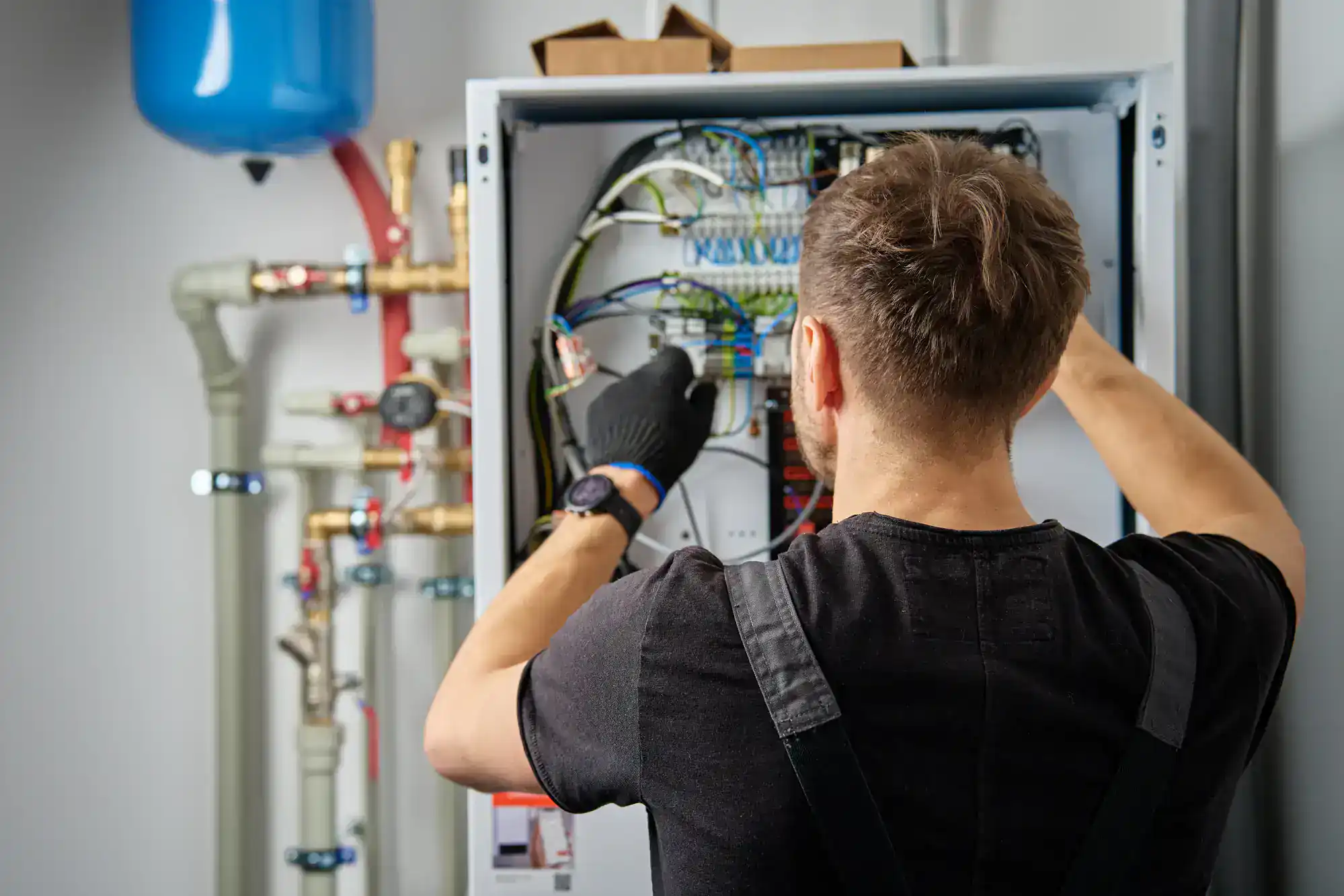
Not sure if your electrical panel needs an upgrade? Here's what the difference between 100 and 200 amp service actually means for your home.
Share:

Summary:
Your electrical panel doesn’t announce when it’s struggling. It just starts tripping breakers at the worst possible times — usually mid-July, usually when the AC is running full blast. For homeowners across Tarrant County, TX, that’s the moment they realize the panel their house came with wasn’t built for the way people actually live now.
This page covers what your panel does, how 100-amp and 200-amp service actually compare, what smart panel technology looks like today, and the warning signs that mean it’s time to stop waiting. No fluff — just the information you need to make a good decision.
Your electrical panel — sometimes called the breaker box or load center — is the distribution hub for every circuit in your home. Power comes in from the utility line, passes through the main breaker, and gets divided out to individual circuits that serve your outlets, appliances, lights, and HVAC system. Each circuit has its own breaker, which trips automatically if the load gets too high, cutting power before wiring overheats.
That tripping function is the safety mechanism. The problem is when it trips not because of a fault, but because the panel simply doesn’t have enough capacity for what you’re asking it to do. That’s a capacity problem, not a safety feature doing its job — and it’s a distinction worth understanding before you call anyone.

Amperage is the measure of how much electrical current your panel can handle at once. A 100-amp panel can manage a certain total load across all your circuits simultaneously. A 200-amp panel can handle double that. The difference isn’t just theoretical — it shows up in circuit count, in headroom for large appliances, and in whether your system can grow with your home.
A standard 100-amp panel typically holds between 20 and 24 circuits. That was a reasonable number for a home built in the 1970s or 1980s, when a typical household ran a refrigerator, a few window units, a washer and dryer, and some lights. It was not designed for a home running central HVAC, a modern kitchen, a home office with multiple devices, and a Level 2 EV charger in the garage.
A 200-amp panel supports 40 to 42 circuits — and in some configurations, more. That additional capacity means you’re not constantly bumping against the ceiling of what your system can handle. It also means room to add circuits later without immediately needing another upgrade. For most homes in Tarrant County built before 2000, that headroom is exactly what’s missing.
One thing worth knowing: adding a subpanel doesn’t solve a capacity problem at the main service level. If your home is fed by 100-amp service from the utility, a subpanel just divides that same 100 amps differently. The total available power doesn’t increase. An actual service upgrade — pulling a new, larger service entrance — is what changes the math.
The honest answer depends on your home’s size, age, and what’s running in it. A 100-amp panel can still be appropriate for a smaller home — under roughly 2,000 square feet — with modest electrical demands and no plans to add major loads. If that describes your situation, an upgrade may not be urgent.
But if your home is larger, if you have central air conditioning, if you’re adding an EV charger, finishing a basement, building an addition, or running a home office with serious equipment — 100-amp service is likely already limiting you, whether you’ve noticed it yet or not.
For most homeowners in Fort Worth and the Mid-Cities, the tipping point has already passed. We work throughout Tarrant County, and a large share of the homes we see — particularly those built before 1990 in neighborhoods like Haltom City, North Richland Hills, and Fort Worth’s established core — are running 100-amp panels that were never designed for today’s electrical loads. The homes haven’t changed structurally, but the demands on them have changed completely.
There’s also the resale and insurance angle. An outdated panel is one of the most common deficiencies flagged during home inspections in this market. Sellers who upgrade before listing remove a negotiating chip from the buyer’s side. And some insurers in Texas are reluctant to write policies — or charge higher premiums — on homes with older, undersized panels. An upgrade isn’t just a comfort improvement; it’s a financial one.
A panel upgrade isn’t a half-day inconvenience stretched into a week-long project. When it’s handled properly, the power-down window is typically four to six hours. The work involves removing the old panel, installing the new one, reconnecting circuits, updating the grounding system if needed, and making sure everything meets current NEC code before the power comes back on.
What most homeowners don’t realize is that Fort Worth and other Tarrant County municipalities require a permit for this work. That permit triggers a city inspection, which is how you know the job was done to code — not just to the contractor’s word. We pull the permit, we schedule the inspection, and we handle that process entirely so you don’t have to manage it.

Some signs are obvious. Breakers that trip repeatedly — especially during summer afternoons when the AC is running — are the most common signal that your electrical panel box is operating at or past its limit. A burning smell near the panel, a warm panel door, or scorch marks around breakers are more urgent. Those aren’t quirks; they’re fire risks.
Other signs are subtler. Lights that dim when you run the microwave or turn on a large appliance. Outlets that don’t work in certain rooms. A panel that still uses fuses instead of breakers. A panel brand like Federal Pacific or Zinsco — both of which have documented safety issues and are common in DFW homes built between the 1950s and 1980s. If you open your electrical panel box and see either of those names, that’s worth a professional evaluation regardless of whether you’ve had problems yet.
Age alone is also a legitimate reason to take a look. Panels are designed to last 25 to 40 years. If yours was installed before 1990, it’s at or past that range. It may be functioning fine today, but “hasn’t failed yet” and “is operating safely” aren’t the same thing — especially in a Texas summer when it’s working harder than it was ever designed to.
The February 2021 winter storm changed how a lot of Tarrant County homeowners think about their electrical infrastructure. After days without power in subfreezing temperatures, the interest in backup generators — and in panels capable of integrating with them — jumped significantly. A modern 200-amp panel is the foundation that makes generator integration, whole-house surge protection, and future upgrades actually possible.
Beyond the standard 200-amp upgrade, there’s a newer category worth knowing about: the smart electrical panel. Manufacturers like Span, Leviton, and Siemens now offer panels that go well beyond simply distributing power. A smart panel gives you circuit-level monitoring through a smartphone app, letting you see exactly how much power each circuit is drawing in real time. You can turn individual circuits on or off remotely, set usage limits, and get alerts when something unusual is happening.
For homeowners in Tarrant County who are adding solar panels, battery storage, or EV chargers, smart panels are particularly relevant. They can manage load automatically — shifting power away from lower-priority circuits during peak demand — which matters a lot in a Texas summer when ERCOT is under strain and you’re trying to keep the AC running without spiking your bill. That kind of intelligent load management isn’t available on a conventional panel, no matter how new it is.
The cost is higher than a standard panel upgrade, and for many homes, a straightforward 200-amp panel is the right call. But if you’re already planning to add solar, a battery backup system, or a home EV charging setup, the smart panel conversation is worth having before you commit to a conventional install. Doing it in stages often costs more in the long run.
We work with homeowners across the DFW Metroplex and Mid-Cities area who are at different points in this decision. Some need a basic upgrade to stop tripping breakers. Others are building out a more connected home and want the infrastructure to support it. The right answer depends on where you are now and where you’re headed — and that’s a conversation, not a sales pitch.
If you’ve made it this far, you probably have a clearer sense of where your home stands. Whether it’s repeated breaker trips, an aging panel that predates the internet, or a project that’s outgrown your current service capacity — the underlying question is the same: does your electrical system match what your home actually needs today?
For most homes in Tarrant County built before 2000, the answer is no. And the gap between what the panel was designed for and what it’s being asked to do tends to grow, not shrink, as time goes on.
We’ve been doing this work in Fort Worth and the Mid-Cities for over 25 years. We’re family-owned, we pull permits, we use UL-listed materials, and we give you a straight answer about what your home needs before any work begins. If you’re ready to get a clear picture of where your panel stands, reach out — we’re easy to get ahold of, and we won’t make it complicated.
Article details:
Share:
Continue learning: